

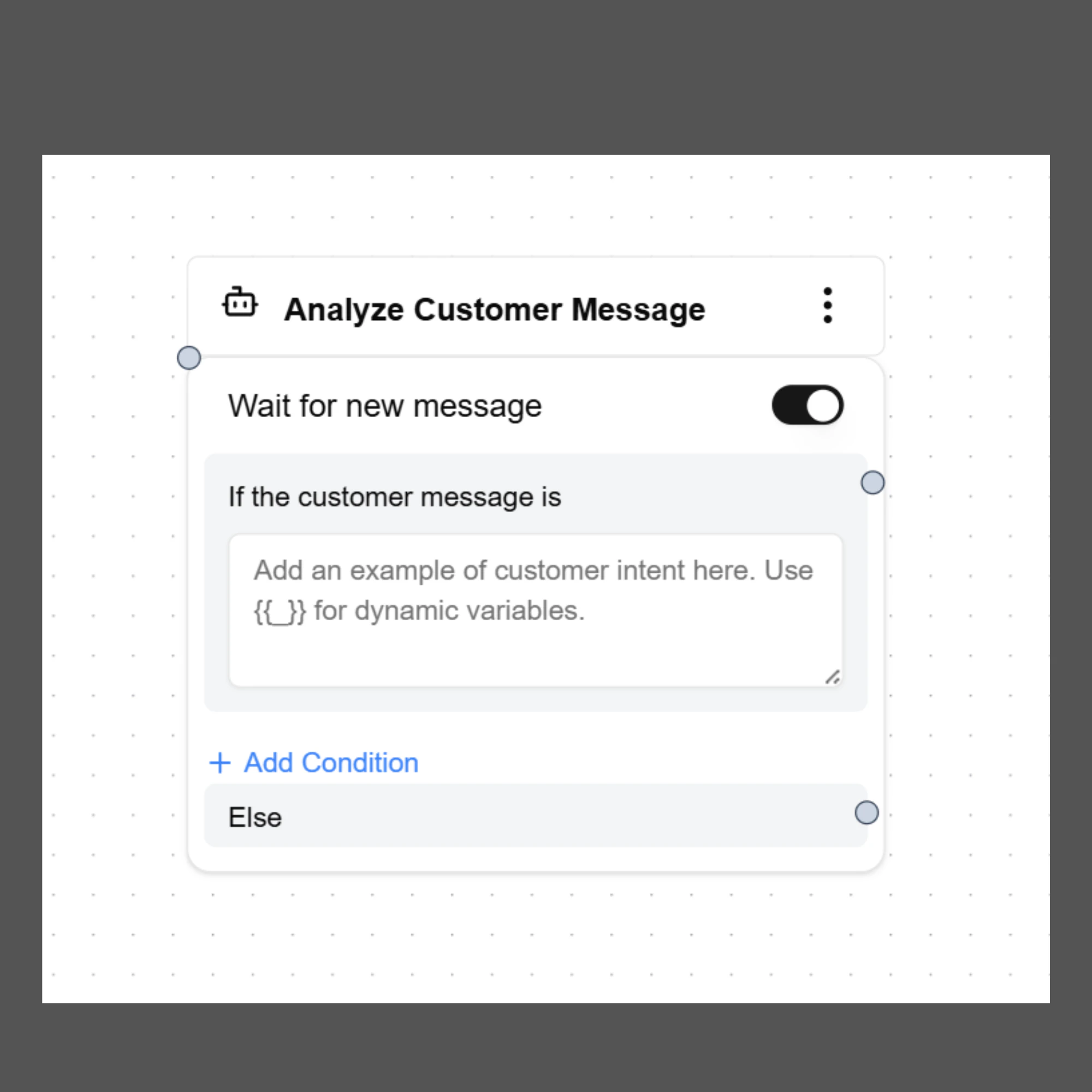
How It Works
When the Analyze Customer Message Node runs, the agent analyzes the customer’s message and checks whether it matches any configured conditions. If a condition matches, the conversation follows the corresponding path connected to that condition. If none of the conditions match, the flow continues through the Else path. This allows developers to design flexible workflows that respond dynamically to customer messages.Wait for New Message
The Wait for new message toggle determines whether the agent should wait for the customer’s next response before analyzing the message. Enabled The agent pauses and waits for the user to send a message. Once the message is received, the node analyzes it and routes the conversation accordingly. Disabled The node immediately analyzes the latest available customer message in the conversation. This option is commonly used when the agent has just asked a question and needs to evaluate the customer’s reply.Defining Message Conditions
Inside the If the customer message is field, you can define conditions that represent the possible intents or message types you want the agent to detect. Each condition represents a possible interpretation of the customer’s response. Example conditions: Customer wants to cancel the orderCustomer accepts the offered discount
Customer declines the discount
Customer requests to speak with a human agent The agent will compare the customer’s message against these conditions and follow the corresponding branch when a match is detected.
Adding Multiple Conditions
You can configure multiple message conditions by clicking Add Condition. Each condition creates a separate branch in the conversation flow. Example workflow: Condition 1Customer wants to cancel the order Condition 2
Customer accepts the discount offer Condition 3
Customer declines the discount and still wants cancellation Each condition can connect to a different Send Response node, Tool Action, or another workflow node.
Else Path
The Else path is used when the customer’s message does not match any of the configured conditions. This ensures the conversation continues smoothly even when the agent cannot clearly detect the expected intent. Common uses for the Else path include: Asking the user to clarify their requestRepeating the previous question
Providing additional guidance Example response: “Sorry, I didn’t quite understand that. Could you please confirm if you would like to cancel the order or continue with it?”
Example Use Case
A customer wants to cancel their order.- The agent asks why the customer wants to cancel.
- The Analyze Customer Message Node evaluates the customer’s reply.
→ Proceed with the order cancellation flow. If the customer is unsure
→ Offer a retention discount. If the customer accepts the discount
→ Confirm the discount and keep the order active. If the customer declines the discount
→ Continue with cancellation. This allows the agent to handle customer conversations more intelligently instead of following a rigid script.