

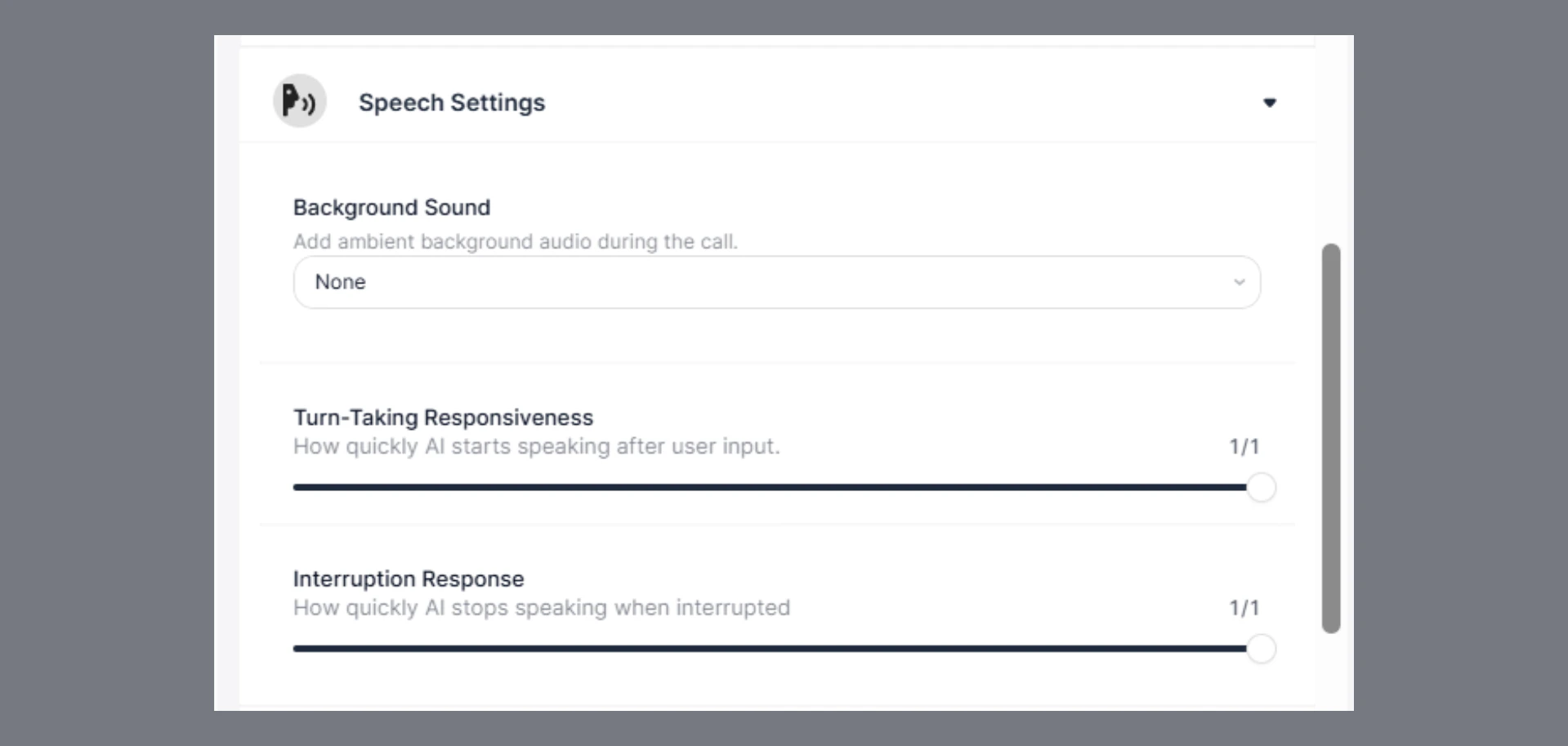
Available Settings
1. Background Sound
This setting lets you add ambient audio during a call to make conversations feel more realistic. Available Options:- None (Default)
No background sound is played. - Office Ambient
Adds subtle office background noise (e.g., distant chatter, workspace sounds). - Keyboard Typing
Adds light typing sounds to simulate an active working environment.
- Open your agent in the Agent Builder
- From the right-side panel, click on Agent Settings
- Go to Speech Settings
- Locate Background Sound
- Click the dropdown
- Select one of the available options
- Use None → For clean, distraction-free conversations
- Use Office Ambient → To simulate a professional environment
- Use Keyboard Typing → To create a “live agent working” feel
2. Turn-Taking Responsiveness
Controls how quickly the AI starts speaking after the user finishes their input. Range:- 0 (Slower Response) → Slight delay before the agent responds
- 1 (Instant Response) → Agent responds immediately
- 1 (Fast response)
- Lower values → More natural pauses, less interruption risk
- Higher values → Faster replies, more responsive feel
3. Interruption Response
Controls how quickly the AI stops speaking when the user interrupts. Range:- 0 (Low Responsiveness) → Agent continues speaking longer before stopping
- 1 (High Responsiveness) → Agent stops immediately when interrupted
- 1 (Highly responsive)
- Lower values → Better for structured or scripted conversations
- Higher values → Better for dynamic, back-and-forth conversations
Best Practices
- Use fast Turn-Taking Responsiveness for real-time conversational agents
- Reduce responsiveness slightly if conversations feel too abrupt
- Keep Interruption Response high for natural dialogue flow
- Lower interruption responsiveness for presentations or guided flows
- Use background sound sparingly to avoid distraction