

- Multi-step conversations
- Automated workflows
- Context-aware responses
- Cross-channel support
How Conversational Flows Work
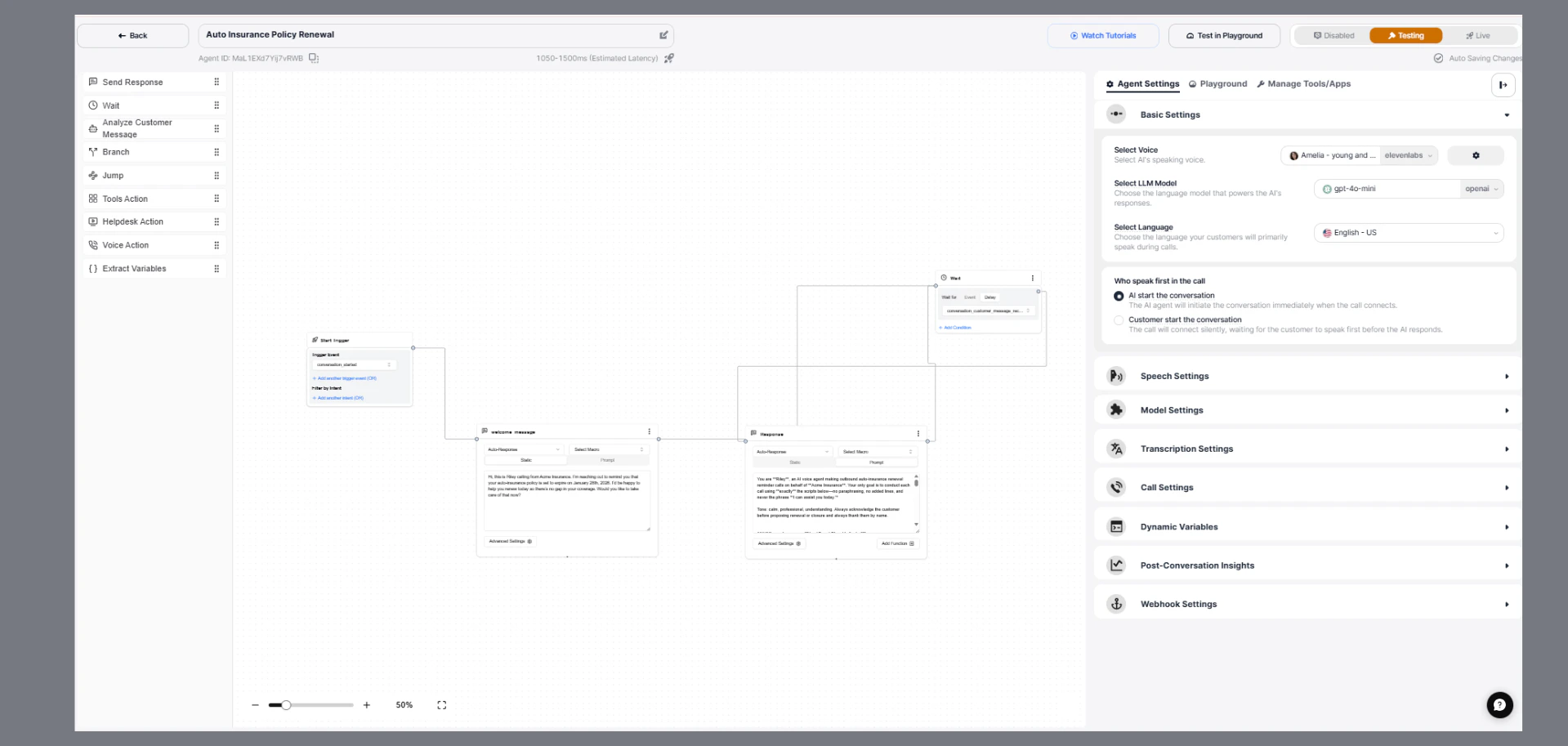
A conversational flow follows a structured sequence:- A conversation begins
- The AI agent is triggered
- The agent responds or asks for input
- The user replies
- The system analyzes the message
- Actions or decisions are executed
- The conversation continues until completion
1. Start Trigger (Entry Point)
The Start Trigger defines when an AI agent workflow begins. It acts as the entry point of every conversational flow. When a new agent is created:- The Start Trigger node is automatically added
- It cannot be removed or replaced
- All other nodes connect after it
Trigger Event
Conversation Started (Default Event) SigmaMind currently supports one trigger event:- Conversation Started
Supported Scenarios
- Chat initiated via helpdesk
- Incoming support email
- Slack or WhatsApp conversation
- Inbound phone call
- Outbound system call (e.g., callback)
Configuration Options
Multiple Conditions- Add multiple conditions using OR logic
- The flow starts if any condition is satisfied
- Restrict agent activation based on user intent
- Uses pre-trained intents from SigmaMind AI
- Requires high confidence (>95%)
Not recommended for: voice-first interactions
Important Note
For voice conversations, intent is typically detected later in the flow using the Analyze Customer Message node.2. Core Nodes in Conversational Flow
After the Start Trigger, different nodes are used to design the conversation.Send Response
The Send Response node is used to communicate with users. It supports:- Dynamic prompts
- Predefined templates (macros)
- Channel-specific messaging
Analyze Customer Message
The Analyze Customer Message node helps the AI understand what the user is saying and route the conversation accordingly. It evaluates the customer’s message against defined conditions and directs the flow based on the best match. If no match is found, the conversation follows the Else path. 👉 Used to detect user intent and enable multi-path conversations. (See Analyze Customer Message documentation for details.)Wait
The Wait node pauses the flow until a specific event occurs. It allows:- Waiting for user replies
- Adding time delays
- Controlling conversational timing
Tool Actions
The Tool Actions node connects the agent to external systems via APIs. It enables:- Data retrieval (e.g., order details)
- Performing actions (e.g., updating records)
Branch
The Branch node introduces decision-making into the flow. It supports:- Conditional logic (AND/OR)
- Data-based routing (e.g., API responses)
3. Designing Conversational Flows
A complete conversational flow is created by connecting nodes in a logical sequence.Typical Flow Structure
- Start Trigger
- Send Response (Greeting)
- Wait (User Input)
- Analyze Customer Message
- Tool Actions (Fetch Data / Perform Action)
- Branch (Decision Making)
- Send Response
- Loop back to Wait
4. Example Use Case: Order Cancellation
Flow Overview
- Conversation starts
- User requests order cancellation
- Message is analyzed
- Order details are retrieved via App Actions
- Eligibility is checked using Branch
- AI offers a retention discount
- Waits for user response
- Continues based on user decision
5. Looping Mechanism
Looping is a key concept in conversational design. After responding, the flow can reconnect to the Wait node, allowing:- Continuous interaction
- Multi-turn conversations
- Decision-based progression
6. Testing in Playground
SigmaMind provides a Playground to test conversational flows.What to Validate
- Trigger activation
- Node execution flow
- Message analysis accuracy
- API responses
- Final output See Test Your Agent documentation for detailed info.
7. Best Practices
- Keep flows simple and modular
- Use clear and specific conditions in Analyze Customer Message
- Add fallback (Else) responses
- Use branching for personalization
- Always include Wait nodes for interaction
- Test multiple scenarios before deployment
Conclusion
SigmaMind’s Conversational Flow Builder allows you to design scalable, intelligent AI agents by combining:- A fixed entry point (Start Trigger)
- Modular conversation nodes
- Message-based routing (Analyze Customer Message)
- API integrations (Tool Actions)
- Conditional logic (Branch)
- Continuous interaction (Wait + looping)