> ## Documentation Index
> Fetch the complete documentation index at: https://docs.sigmamind.ai/llms.txt
> Use this file to discover all available pages before exploring further.
# Navigate IVR
The **Navigate IVR** tool allows your AI agent to automatically handle Interactive Voice Response (IVR) systems it encounters during a call. Instead of getting stuck at a phone menu, the agent listens to the IVR prompts and responds with the correct inputs — navigating menus on its own until it reaches a live human or the target destination.
 > **Phone calls only.** This tool works exclusively for voice calls and is not available for web or chat agents.
***
## When to Use
Configure this tool when your agent needs to:
* Make an outbound call to a business that has an IVR phone menu
* Navigate a multi-level menu to reach a billing agent, support team, or specific department
* Bypass automated menus and connect directly to a human representative
* Handle outbound campaigns where the destination number has an IVR system
***
## Steps to Add
1. Open the **Agent Builder**
2. Click **+ Add Tool**
3. Select **Navigate IVR** from the tool menu
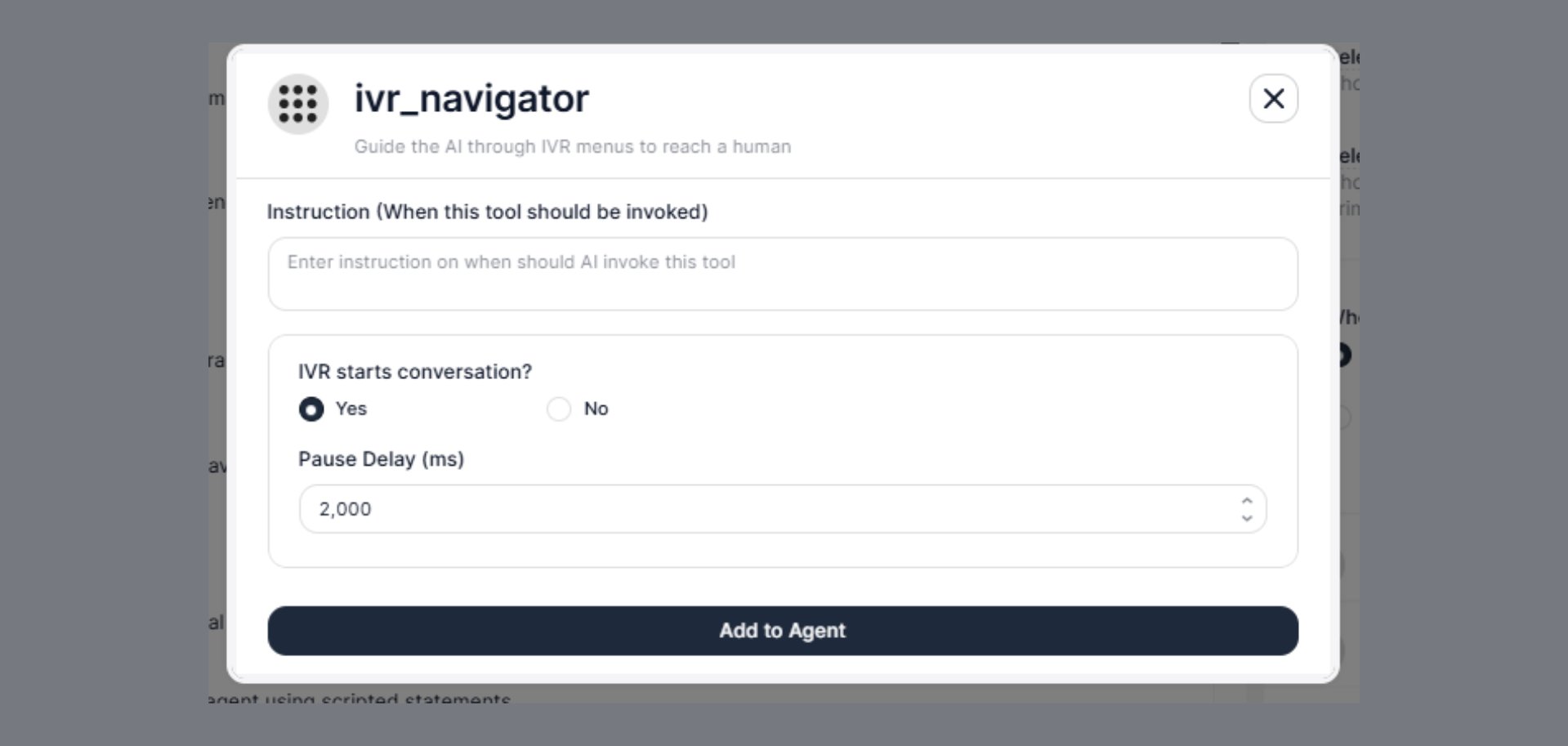
4. A configuration modal will appear — fill in all fields (described below)
5. Click **Add to Agent**
***
## Configuration Fields
### Instruction *(When this tool should be invoked)*
Write a clear instruction that tells the AI agent when to trigger IVR navigation. The agent uses this to decide the right moment to activate the tool during a live call.
```text theme={null}
Invoke this tool as soon as the outbound call connects and an IVR menu is detected.
```
```text theme={null}
Use the IVR navigator when the call connects and the system starts playing an automated menu
before a human agent is available.
```
Be specific — if the instruction is too broad, the agent may try to navigate IVR when talking to a human, or not trigger it at all when a menu appears.
***
### IVR Starts Conversation?
This setting tells the agent whether the IVR system is the **first thing that speaks** when the call connects, or whether the call connects to silence or ringing first.
| Option | When to Use |
| ------- | ---------------------------------------------------------------------------------------------------------------------------- |
| **Yes** | The IVR plays an automated greeting immediately when the call connects (e.g., "Thank you for calling. Press 1 for Sales...") |
| **No** | The call connects with silence or ringing first, and the IVR starts after a delay or human pickup attempt |
#### Why This Matters
When **Yes** is selected, the agent knows to start listening for IVR prompts from the very first second of the call. It will not wait for a human greeting — it immediately enters navigation mode.
When **No** is selected, the agent waits for its turn to speak first (as configured in **Basic Settings → Who speaks first**) before checking for IVR prompts. This avoids misidentifying a human as an IVR system.
**Default:** `Yes`
Setting this incorrectly causes one of two problems:
* Set to **Yes** when a human answers → agent tries to navigate a person using DTMF tones
* Set to **No** when IVR answers immediately → agent misses the first prompt and fails to navigate
***
### Pause Delay (ms)
The number of milliseconds the agent waits **after detecting an IVR prompt** before responding. This simulates a natural pause and ensures the IVR has finished speaking before the agent sends its response.
**Default:** `2,000` ms (2 seconds)
| Pause Delay | Behaviour |
| -------------- | ------------------------------------------------------------------------ |
| `500–1000 ms` | Very fast response — may cut off longer IVR announcements |
| `2000 ms` | Standard — works for most IVR systems |
| `3000–5000 ms` | Slow response — use for IVR systems with long prompts or slow processing |
#### Why Pause Delay Matters
IVR systems are not instant. They play a recorded message and then wait for input. If the agent responds too quickly, the DTMF tone may be sent while the announcement is still playing — and some IVR systems reject early inputs.
If the agent responds too slowly, the IVR may interpret silence as a non-response and either repeat the menu or route to a default option.
**When to increase the delay:**
* The IVR plays a long welcome message before the menu options
* The destination uses an older PBX system with slow prompt processing
* The agent is consistently navigating to the wrong option
**When to decrease the delay:**
* The IVR responds quickly and your campaigns need faster connection times
* You've tested the flow and confirmed the IVR accepts early inputs without issue
***
## How the Agent Navigates IVR
Once the tool is triggered, the agent:
1. **Listens** for the IVR prompt (menu options, recorded announcements)
2. **Waits** for the configured Pause Delay
3. **Responds** with the correct DTMF key press or spoken input based on the prompt
4. **Repeats** for each menu level until the destination is reached
5. **Hands off** to the next tool (e.g., records a message, delivers information, transfers the customer in)
The agent uses the context of your system prompt and the IVR prompts it hears to decide which option to select at each step. You do not need to pre-map every menu level manually — the agent reasons through the options based on its goal.
***
## Real-World Example
**Scenario:** An outbound agent is calling a hospital to reschedule a patient appointment. The hospital line has a multi-level IVR.
**IVR flow:**
```text theme={null}
"Thank you for calling City Hospital."
"Press 1 for appointments."
"Press 2 for billing."
"Press 3 for emergency."
→ Agent presses 1
"Press 1 to book a new appointment."
"Press 2 to reschedule an existing appointment."
→ Agent presses 2
"Please hold while we connect you to scheduling."
→ Human agent answers
→ AI agent continues the conversation
```
**Configuration:**
| Field | Value |
| ------------------------ | -------------------------------------------------------------------------------------- |
| Instruction | Invoke this tool immediately when the call connects and an automated menu is detected. |
| IVR Starts Conversation? | Yes |
| Pause Delay | 2,000 ms |
***
## Combining with Other Tools
| Tool | How They Work Together |
| ----------------------------- | ------------------------------------------------------------------------------------ |
| **Extract Dynamic Variables** | Capture appointment details or customer intent before navigating IVR |
| **Transfer Call** | After IVR navigation connects to a human, transfer the customer in via warm transfer |
| **End Call** | If navigation fails or the IVR cannot be resolved, end the call cleanly |
***
## Best Practices
* Set **IVR Starts Conversation?** to **Yes** for most outbound use cases — the vast majority of business phone lines play an IVR immediately on connection
* Start with the **default 2,000 ms** Pause Delay and increase only if you observe navigation errors during testing
* Write a specific **Instruction** that references the call context (e.g., "when the call connects to the hospital line") to avoid the tool triggering on human conversations
* Test the full IVR flow using the **Test Voice** playground before deploying your campaign
* If the target IVR changes its menu structure, update the agent's system prompt to reflect the new options — no tool reconfiguration needed
***
## Troubleshooting
| Issue | Fix |
| ---------------------------------------- | ------------------------------------------------------------------------ |
| Agent not navigating at all | Check that the Instruction condition is specific enough to trigger |
| Agent presses the wrong option | Add more detail to your system prompt describing the correct menu path |
| IVR prompt cut off before agent responds | Increase Pause Delay by 500–1,000 ms |
| Agent treats human greeting as IVR | Set **IVR Starts Conversation?** to **No** |
| Navigation stops mid-flow | The IVR may have changed its menu — update the system prompt accordingly |
> **Phone calls only.** This tool works exclusively for voice calls and is not available for web or chat agents.
***
## When to Use
Configure this tool when your agent needs to:
* Make an outbound call to a business that has an IVR phone menu
* Navigate a multi-level menu to reach a billing agent, support team, or specific department
* Bypass automated menus and connect directly to a human representative
* Handle outbound campaigns where the destination number has an IVR system
***
## Steps to Add
1. Open the **Agent Builder**
2. Click **+ Add Tool**
3. Select **Navigate IVR** from the tool menu
4. A configuration modal will appear — fill in all fields (described below)
5. Click **Add to Agent**
***
## Configuration Fields
### Instruction *(When this tool should be invoked)*
Write a clear instruction that tells the AI agent when to trigger IVR navigation. The agent uses this to decide the right moment to activate the tool during a live call.
```text theme={null}
Invoke this tool as soon as the outbound call connects and an IVR menu is detected.
```
```text theme={null}
Use the IVR navigator when the call connects and the system starts playing an automated menu
before a human agent is available.
```
Be specific — if the instruction is too broad, the agent may try to navigate IVR when talking to a human, or not trigger it at all when a menu appears.
***
### IVR Starts Conversation?
This setting tells the agent whether the IVR system is the **first thing that speaks** when the call connects, or whether the call connects to silence or ringing first.
| Option | When to Use |
| ------- | ---------------------------------------------------------------------------------------------------------------------------- |
| **Yes** | The IVR plays an automated greeting immediately when the call connects (e.g., "Thank you for calling. Press 1 for Sales...") |
| **No** | The call connects with silence or ringing first, and the IVR starts after a delay or human pickup attempt |
#### Why This Matters
When **Yes** is selected, the agent knows to start listening for IVR prompts from the very first second of the call. It will not wait for a human greeting — it immediately enters navigation mode.
When **No** is selected, the agent waits for its turn to speak first (as configured in **Basic Settings → Who speaks first**) before checking for IVR prompts. This avoids misidentifying a human as an IVR system.
**Default:** `Yes`
Setting this incorrectly causes one of two problems:
* Set to **Yes** when a human answers → agent tries to navigate a person using DTMF tones
* Set to **No** when IVR answers immediately → agent misses the first prompt and fails to navigate
***
### Pause Delay (ms)
The number of milliseconds the agent waits **after detecting an IVR prompt** before responding. This simulates a natural pause and ensures the IVR has finished speaking before the agent sends its response.
**Default:** `2,000` ms (2 seconds)
| Pause Delay | Behaviour |
| -------------- | ------------------------------------------------------------------------ |
| `500–1000 ms` | Very fast response — may cut off longer IVR announcements |
| `2000 ms` | Standard — works for most IVR systems |
| `3000–5000 ms` | Slow response — use for IVR systems with long prompts or slow processing |
#### Why Pause Delay Matters
IVR systems are not instant. They play a recorded message and then wait for input. If the agent responds too quickly, the DTMF tone may be sent while the announcement is still playing — and some IVR systems reject early inputs.
If the agent responds too slowly, the IVR may interpret silence as a non-response and either repeat the menu or route to a default option.
**When to increase the delay:**
* The IVR plays a long welcome message before the menu options
* The destination uses an older PBX system with slow prompt processing
* The agent is consistently navigating to the wrong option
**When to decrease the delay:**
* The IVR responds quickly and your campaigns need faster connection times
* You've tested the flow and confirmed the IVR accepts early inputs without issue
***
## How the Agent Navigates IVR
Once the tool is triggered, the agent:
1. **Listens** for the IVR prompt (menu options, recorded announcements)
2. **Waits** for the configured Pause Delay
3. **Responds** with the correct DTMF key press or spoken input based on the prompt
4. **Repeats** for each menu level until the destination is reached
5. **Hands off** to the next tool (e.g., records a message, delivers information, transfers the customer in)
The agent uses the context of your system prompt and the IVR prompts it hears to decide which option to select at each step. You do not need to pre-map every menu level manually — the agent reasons through the options based on its goal.
***
## Real-World Example
**Scenario:** An outbound agent is calling a hospital to reschedule a patient appointment. The hospital line has a multi-level IVR.
**IVR flow:**
```text theme={null}
"Thank you for calling City Hospital."
"Press 1 for appointments."
"Press 2 for billing."
"Press 3 for emergency."
→ Agent presses 1
"Press 1 to book a new appointment."
"Press 2 to reschedule an existing appointment."
→ Agent presses 2
"Please hold while we connect you to scheduling."
→ Human agent answers
→ AI agent continues the conversation
```
**Configuration:**
| Field | Value |
| ------------------------ | -------------------------------------------------------------------------------------- |
| Instruction | Invoke this tool immediately when the call connects and an automated menu is detected. |
| IVR Starts Conversation? | Yes |
| Pause Delay | 2,000 ms |
***
## Combining with Other Tools
| Tool | How They Work Together |
| ----------------------------- | ------------------------------------------------------------------------------------ |
| **Extract Dynamic Variables** | Capture appointment details or customer intent before navigating IVR |
| **Transfer Call** | After IVR navigation connects to a human, transfer the customer in via warm transfer |
| **End Call** | If navigation fails or the IVR cannot be resolved, end the call cleanly |
***
## Best Practices
* Set **IVR Starts Conversation?** to **Yes** for most outbound use cases — the vast majority of business phone lines play an IVR immediately on connection
* Start with the **default 2,000 ms** Pause Delay and increase only if you observe navigation errors during testing
* Write a specific **Instruction** that references the call context (e.g., "when the call connects to the hospital line") to avoid the tool triggering on human conversations
* Test the full IVR flow using the **Test Voice** playground before deploying your campaign
* If the target IVR changes its menu structure, update the agent's system prompt to reflect the new options — no tool reconfiguration needed
***
## Troubleshooting
| Issue | Fix |
| ---------------------------------------- | ------------------------------------------------------------------------ |
| Agent not navigating at all | Check that the Instruction condition is specific enough to trigger |
| Agent presses the wrong option | Add more detail to your system prompt describing the correct menu path |
| IVR prompt cut off before agent responds | Increase Pause Delay by 500–1,000 ms |
| Agent treats human greeting as IVR | Set **IVR Starts Conversation?** to **No** |
| Navigation stops mid-flow | The IVR may have changed its menu — update the system prompt accordingly |